
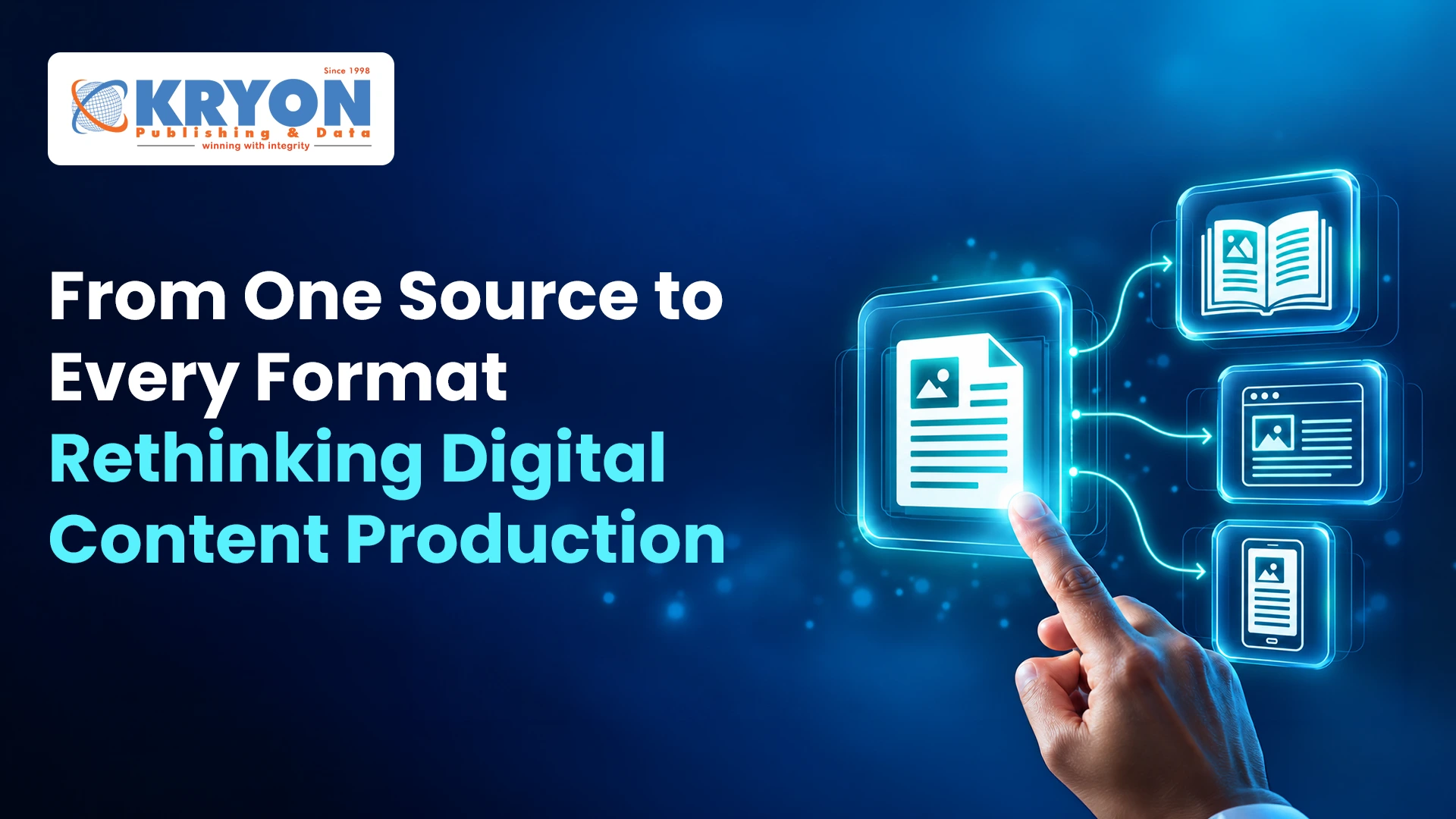
Digital publishing is no longer focused on producing a single final document. The same content may need to be delivered as a PDF, HTML page, EPUB, accessible digital publication, repository-ready file, or another platform-specific format.
When each output is created and maintained independently, production can become repetitive. Content may need to be reformatted, corrected, reviewed, and validated several times. Even a small change to a paragraph, table, reference, or figure can require updates across multiple versions.
A structured approach to content production offers a different model: create and manage content in a reusable form that can support multiple publishing outputs.
Traditional publishing workflows often concentrate on the final document. Content may first be prepared for print or PDF and later adapted for websites, eBooks, digital archives, or other channels.
As the number of outputs increases, this approach can create additional production work. Teams may have to maintain multiple files, repeat formatting activities, apply the same corrections in different places, and verify consistency between versions.
For publishers handling large volumes of journals, books, technical documentation, educational materials, and archival content, these repeated processes can become increasingly difficult to manage.
The challenge is therefore not simply producing more formats. It is establishing an underlying content structure that can support different publishing requirements.
A content-centric workflow focuses on the structure and meaning of information rather than tying content immediately to a particular visual layout.
Markup technologies such as XML, HTML, and LaTeX can be used within publishing environments to organize and represent content in structured ways. Kryon Publishing itself identifies these technologies as part of its markup-language expertise and structured publishing capabilities.
Depending on the content model, elements such as titles, headings, paragraphs, figures, tables, references, and other components can be identified systematically. Presentation requirements can then be handled according to the needs of each output.
This separation between content structure and presentation can make information easier to transform, manage, and reuse.
A well-structured source can provide the foundation for creating multiple publication formats.
Depending on the project and publishing requirements, structured content may support outputs such as PDF, HTML, EPUB, accessible digital content, and repository or platform-ready formats. Kryon Publishing's current services include structured publishing, multi-format conversion, EPUB production, HTML-based content, and digital accessibility work.
However, a common source does not mean every output can be produced without additional work.
Each format has its own technical and presentation requirements. EPUB, for example, is a structured digital publication format built using technologies including HTML and CSS, with specific requirements for packaging, navigation, semantics, and reading-system compatibility.
Each final format therefore needs appropriate transformation, validation, and quality assurance.
One of the practical benefits of structured content is the ability to manage information more consistently.
Consider a correction to an author affiliation, paragraph, reference, or table. When every output exists as an independently maintained file, the correction may need to be repeated and verified across several versions.
With a controlled structured source, changes can instead be managed at the content level and incorporated into relevant outputs according to the publishing workflow.
This can reduce duplicated work and help minimize inconsistencies between formats. Final outputs still require quality checks because correct source content does not automatically guarantee correct rendering or functionality in every delivery environment.
The value of structured publishing extends beyond generating different file formats.
When content is organized into identifiable components, it can be easier to transform, repurpose, migrate, or deliver through different systems. This is particularly relevant to scholarly publishing, technical documentation, educational materials, reference content, and large digital collections.
Instead of treating the final PDF or EPUB as the only valuable asset, publishers can treat the underlying structured content as a reusable resource.
This can provide greater flexibility when content needs to be updated or delivered through new channels in the future.
Structured content can also provide a stronger foundation for accessibility.
Meaningful headings, appropriate content hierarchy, correctly structured tables, alternative text, language information, and other semantic information can contribute to the creation of accessible digital publications.
However, structured content alone does not guarantee accessibility. EPUB accessibility, for example, has dedicated conformance requirements in addition to the core EPUB specification.
Accessibility therefore needs to be considered throughout production and verified in the final format rather than assumed from the source structure alone.
The shift toward multi-format publishing requires a broader view of content production.
Instead of rebuilding the same information separately for each channel, publishers can establish a structured source, apply controlled transformations for different formats, and perform the necessary quality and accessibility checks on the resulting outputs.
The result is a publishing model designed around content reuse, consistency, adaptability, and multi-format delivery rather than a collection of disconnected files.
As publishing expands across formats, devices, and platforms, content needs to remain useful beyond its original output.
A structured, source-focused approach can help publishers manage content more consistently, support multiple delivery formats, simplify future transformations, and create a stronger foundation for accessibility and reuse.
At Kryon Publishing, expertise in XML, HTML, LaTeX, multi-format conversion, accessibility, and digital publishing workflows supports organizations in transforming content for different publishing and distribution requirements.
The objective is not simply to create the same publication in more formats. It is to create structured content that can continue to deliver value wherever and however it needs to be published.
Structured digital content production organizes information into identifiable components so the same underlying content can support multiple publishing and delivery requirements.
Yes. Depending on the workflow and content structure, a common source can support formats such as PDF, HTML, EPUB, and other digital outputs. Each format still requires appropriate transformation and validation.
It can reduce repetitive content handling, improve consistency across outputs, and make content easier to transform, update, reuse, and deliver through different channels.
No. Good content structure provides a stronger foundation for accessibility, but final outputs must still meet applicable accessibility requirements and undergo appropriate validation.
XML can represent content components and their relationships in a structured form, helping publishers separate content from presentation and support transformation into multiple publishing formats.




Copyright @ 2025, Kryon Publishing Services. All Rights Reserved

