
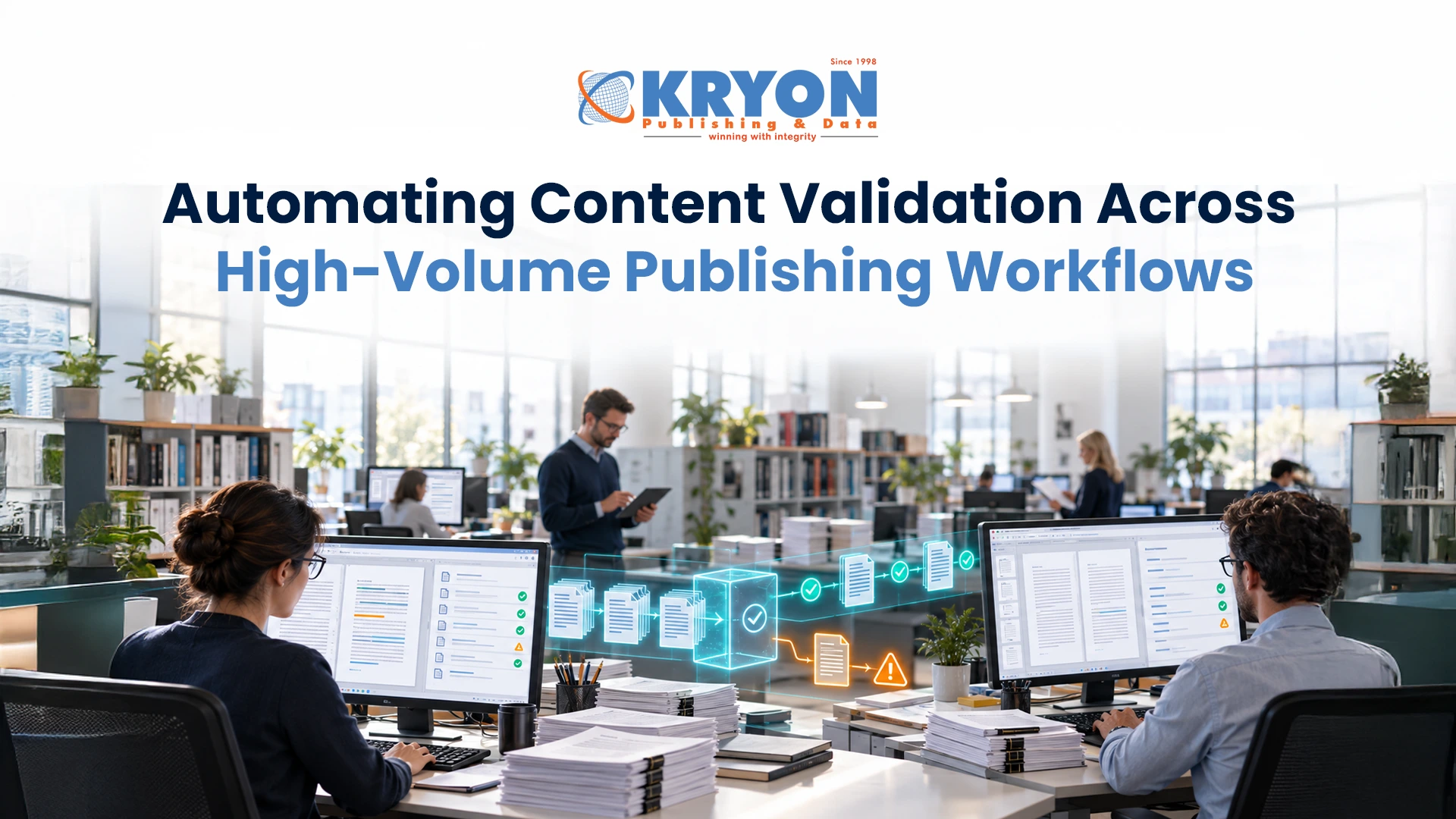
High-volume publishing environments may process large numbers of journal articles, books, educational materials, technical documents, and other digital content. Each publication can move through multiple stages, including content preparation, copyediting, typesetting, conversion, quality control, and final delivery.
As content volumes increase, maintaining consistent validation across every file can become increasingly challenging.
Production teams may need to check structural accuracy, metadata completeness, references, figures, tables, hyperlinks, formatting, and publication-specific requirements. When the same content is delivered in formats such as XML, HTML, EPUB, and PDF, additional format-specific checks may also be required.
Manual quality control remains essential, but many validation activities are repetitive and rule-based. Checking every file manually for predictable issues can require significant production effort and may make high-volume workflows difficult to scale.
Errors identified late in production can also create additional work. A missing figure reference, invalid XML element, incomplete metadata field, unresolved cross-reference, or broken hyperlink may require correction, regeneration, and another round of validation.
Publishers therefore need a validation approach that can identify predictable content issues earlier and more consistently, while retaining professional review for areas requiring editorial, visual, accessibility, or contextual judgment.
Kryon Publishing can support a structured validation approach by incorporating automated and rule-based checks at appropriate stages of the publishing workflow. Validation can be configured according to content type, source format, output requirements, client specifications, and applicable publishing standards.
1. Structural and Schema Validation
For structured content such as XML, automated validation can check files against defined schemas or content models.
This can help identify missing mandatory elements, incorrect attributes, invalid element placement, and other detectable structural issues before content progresses to subsequent production stages.
2. Content and Consistency Validation
Rule-based checks can help identify predefined inconsistencies across large volumes of content.
Depending on project requirements, validation may cover numbering patterns, formatting variations, missing information, terminology inconsistencies, incomplete metadata, and other detectable conditions.
Issues requiring interpretation can be flagged for professional review rather than automatically corrected.
3. Reference and Cross-Link Validation
Publishing content may contain citations, hyperlinks, figure references, table references, footnotes, and internal cross-references.
Configured automated checks can help identify detectable issues such as broken links, unresolved internal references, or missing targets. Issues that require contextual interpretation or external verification can remain subject to professional review.
4. Figure and Asset Validation
Figures, images, supplementary materials, and other publication assets can be evaluated against predefined production requirements.
Validation rules can check whether expected assets are present and whether selected technical properties meet configured specifications. Any identified exceptions can then be directed to production specialists for further review.
5. Multi-Format Output Validation
A structurally correct source does not automatically guarantee that every generated output will be correct.
XML, HTML, EPUB, and PDF have different technical, presentation, and delivery requirements. Validation should therefore extend to relevant final outputs where appropriate.
Automated checks can support technical verification, while visual presentation, complex layouts, accessibility considerations, and other judgment-based requirements can remain part of professional quality assurance.
6. Exception-Based Quality Control
Instead of requiring production teams to manually search every file for every known issue, automated validation can flag content that does not meet predefined rules.
Publishing specialists can then concentrate on exceptions and complex content, allowing professional expertise to be directed toward areas where closer investigation or judgment is necessary.
This approach can make automation particularly useful in high-volume environments where the same validation requirements need to be applied repeatedly across many files.
7. Human Review and Final Quality Assurance
Automation should complement rather than replace professional quality control.
Editorial and production specialists remain important for reviewing meaning, context, complex formatting, unusual content structures, accessibility considerations, and other requirements that cannot be reliably assessed through predefined rules alone.
Automated validation is also dependent on the quality and scope of the configured rules. A file passing technical validation does not necessarily mean that it is editorially, visually, or contextually correct.
This creates a balanced process in which automation supports repeatable validation while publishing professionals retain control over final quality decisions.
As publishing volumes grow and content is delivered across multiple formats, relying entirely on manual validation can make quality control increasingly difficult to scale.
Automated content validation can help publishers identify predictable structural, content, metadata, reference, asset, and technical issues earlier in production. Applying validation throughout the workflow can help reduce repetitive checking and identify detectable issues before they progress into later production stages.
Human expertise, however, remains essential. Not every publishing requirement can be represented as an automated rule, and technically valid content is not necessarily editorially, visually, contextually, or accessibility-ready.
At Kryon Publishing, expertise in structured content, XML-based publishing, multi-format production, accessibility, and quality-focused publishing workflows can support organizations in developing validation processes suited to their content and production requirements.
The objective is to combine automated validation for suitable repeatable checks with professional review for complex and judgment-based requirements, supporting more consistent and manageable quality control across high-volume publishing workflows.
Automated content validation uses predefined rules and technical checks to identify structural, formatting, metadata, reference, and other detectable issues during the publishing workflow.
It can help identify repeatable issues across large content volumes, reduce repetitive manual checking, and allow publishing specialists to focus on exceptions and complex quality requirements.
Yes, automated checks can support different stages and formats depending on the workflow. However, each format has specific requirements and may still require format-specific and professional quality review.
No. Automation is best suited to predictable, rule-based checks. Human expertise remains important for editorial meaning, complex formatting, accessibility considerations, visual quality, and contextual decisions.
Earlier validation can help identify detectable issues before they move into later production stages, reducing avoidable rework and supporting more consistent quality control.




Copyright @ 2025, Kryon Publishing Services. All Rights Reserved

